Old Laborer Khantia
“I will get your last rites performed and salvation will be given.”
The Forgotten One
Near the Kainchi ashram, in a crumbling hut that let in both rain and wind, lived an old Nepali labourer named Khantia. He possessed nothing of worldly value: no family, no relatives, no money. His only companions were two cows, and his only possessions a dented plate and a broken tumbler. He had spent his entire life in poverty, invisible to the world. But the heaviest burden he carried was not his destitution — it was the terrifying thought that when he died, there would be no one to perform his last rites, and his soul would wander without peace.
One day, Khantia saw the crowd around Baba. A thought arose in his simple heart: he could offer milk from his beloved cows to the saint. He filled a bottle, walked to the temple, but the crowd intimidated him. Timidly, he poured the milk into the river and returned home, his offering unmade.
The Divine Gaze
On another day, he tried again. He reached the bridge with the bottle, but once more Baba was surrounded by people. Yet this time, Baba’s eyes found the old man instantly. He told Bhuvan Chandra Tewari, “Escort the old man carefully over the bridge.”
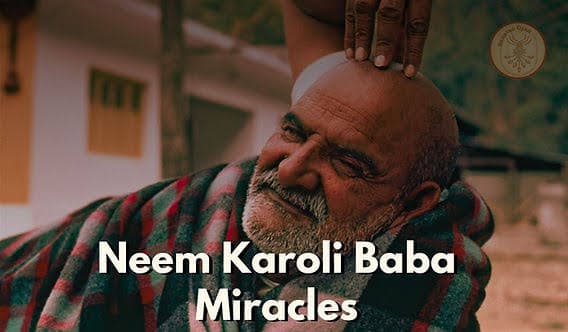
When the trembling Khantia was brought before him, Baba snatched the milk bottle from his hands and, to the astonishment of all, poured the entire contents over his own head. The act was so sudden, so intimate, that tears of love welled up in the old man’s eyes. Baba asked, “What do you want?” In a tremulous voice, Khantia asked for salvation.
Baba’s response was immediate and absolute: “I will get your last rites performed and salvation will be given.” To seal the promise, he extended his hand. When Khantia hesitated, Baba took the old man’s hand in his own — a divine contract witnessed by the universe.
The Saint’s Tears
Baba’s heart was moved to tears by the man’s destitution. He turned to the devotees and described Khantia’s condition with heartbreaking precision: “Rain water drips in his hut. He has a dented plate and a broken tumbler. He has no clothes to wear, no bedding to spread for a comfortable night’s rest.” Immediately, he sent clothes, bedding, utensils, and daily meals from the ashram to the old man’s hut.
When Khantia fell ill, Baba arranged for him to be taken to Ramsay Hospital in Nainital by car, covering all medical expenses. He assigned Haridas Baba to care for him personally. And when the old labourer finally breathed his last, Baba sent thirteen people to perform his last rites, and had the shradh (twelfth‑day rites) conducted at the ashram, exactly as promised. The man who had feared dying alone was honoured like a king, because a saint had promised him salvation.
Reflections
This leela is perhaps the most tender of all. Baba did not perform a dramatic, visible miracle; instead, he poured his grace into the broken vessel of a forgotten man’s life, restoring his dignity piece by piece. The milk poured over Baba’s head symbolised the complete acceptance of the devotee’s offering, no matter how small. Khantia had nothing to give but his love, and that was enough to move the heart of the divine.
The promise of salvation was not a vague hope; it was a contractual guarantee sealed with a handshake. Baba demonstrated that the true measure of a saint is not the grandeur of his miracles but the depth of his compassion for the least of beings. In Khantia, we see our own fears — the fear of being forgotten, of dying alone, of being unworthy. Baba’s response is the eternal reassurance: no one is invisible to God, and the smallest offering of love returns a hundredfold.