The Mahasamadhi Lila
“I am going to be released from Central Jail today.”
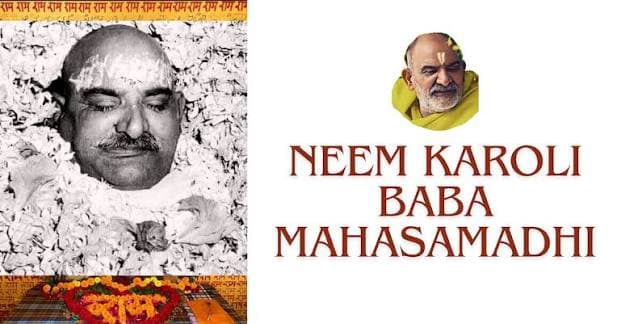
The Day of Departure
The morning of 9 September 1973 dawned like any other over the Kainchi valley, but within the ashram, a subtle shift was palpable. A massive crowd of devotees and Westerners had gathered, singing outside Baba’s kuti. Throughout the day, Baba kept repeating, “I have to go today.” At 10 a.m., he had a ritual bath in Radha Kuti, where Sri Ma and devotees worshipped him with water and milk, treating him like a Shivling. Baba told Sri Ma: “Wherever you may be, all that is auspicious will be with you.”
At 1 p.m., Baba suddenly announced, “I am going now.” He gave instructions to close the kitchen and send the women devotees home. As he walked towards the car, he held devotees’ hands, laughing and talking, as if he were going on a short trip. He said affectionately, “I am going to be released from Central Jail today.” His blanket slipped off his shoulders twice; each time, devotees picked it up and placed it back in the car.
As the car left Kainchi, a brilliant, multicoloured rainbow appeared in the sky, spanning the horizon. It remained visible all the way to Kathgodam, a celestial escort for the departing saint. Baba watched it and said, “Inder, look at this beautiful creation of God. Man cannot create this.”
The Final Journey
That night, Baba boarded the Agra Fort Express. In the train, a devotee offered him milk, which he refused. When the devotee insisted, the milk turned sour — a silent teaching. Baba threw the thermos out of the window and said, “One should not be attached.” On 10 September, he reached Agra, got a shave, and told his host to avoid big houses, warning of “plundering and killing” ahead.
On the night of 10 September, he took the train back. When it stopped at Mathura, he got off and was taken to Vrindavan. He was rushed to the Ramakrishna Mission Hospital. At 1:15 a.m., on the sacred day of Anant Chaturdashi, as doctors prepared to check his blood pressure, Baba pulled the oxygen tube from his nose, pushed the instrument aside, whispered “It is all useless,” and repeated the name of God three times: “Jagdish, Jagdish, Jagdish.” Then his body became still. He had merged into infinity by cardiac arrest.
The Storm and the Vision
His body was brought to the Vrindavan ashram. A fierce debate arose over whether to cremate or bury him, until Baba Leelanand Thakur (Pagal Baba) arrived and decreed that Baba should be cremated at the site of the yagna in the ashram. As the body was brought into the courtyard for the pyre, a terrible, unforeseen storm burst forth. The sky turned pitch black; heavy rain and violent winds shrouded the area, delaying the cremation. Nothing was visible beyond ten paces.
This storm only ceased the exact moment Sri Ma stepped out of her car upon arriving at the ashram. The weather cleared instantly, as if nature itself was waiting for her presence. Baba’s body was placed on a flower‑adorned bier and carried in a grand procession around Vrindavan, accompanied by devotional music. At roughly 9 p.m., the pyre was lit.
As the flames rose, one devotee, Jagmohan Sharma, saw a divine vision: Baba stood amidst the flames, flanked by Lord Ram and Lakshman, while Hanuman ji performed a parikrama around them. Thus ended the physical lila of the great saint, though his devotees testify that his grace and divine presence continue unabated to this day.
Reflections
The Mahasamadhi of Neem Karori Baba is not a story of death; it is a story of liberation. Every detail of those final days was a teaching: the rainbow that accompanied him, the sour milk that taught non‑attachment, the warning of plundering, and the final, triumphant cry of “Jagdish.” The storm that raged until Sri Ma arrived symbolises the truth that the divine feminine energy is an inseparable part of the guru’s work.
Devraha Baba’s declaration, “Baba’s death was not a reality. He is alive and will ever remain so,” is not a sentimental hope; it is the lived experience of thousands who have since felt his presence, received his guidance in dreams, and witnessed his miracles. The Mahasamadhi lila reveals that the body of a saint is merely a garment. The wearer remains, eternal and omnipresent, ready to respond to the call of any heart that utters his name with love.